
Hi, I'm
Abie Marshall.
Turning Complex Data into Scalable Solutions.
Technical solutions architect spanning the full solution lifecycle — from customer requirements and research through to productionised, cloud-native delivery. With a BSc in Physics and MSc in Data Science, I bring deep expertise across software engineering, Earth Observation, geospatial data engineering, CI/CD, and cloud-native infrastructure. I'm passionate about applying this across the entire stack to build geospatial products that create real-world impact.
01. About me
Abie Marshall
Hey! I'm an experienced engineer who enjoys getting stuck into all aspects of the software delivery lifecycle - from requirements gathering, architecture and implementation to testing and deployment. I’m also comfortable putting on my math hat to dive into data science and machine learning, which gives me a unique ability to bridge the gap between research and production.
I've enjoyed applying my skills to solve all kinds of real-world scientific problems, notably the systems that I contributed towards were recognised as part of the solution for the Pfizer – BioNTech COVID-19 vaccine. However, I have a particular passion for geospatial and earth observation data. I have contributed to several publications in this area mostly focussed on applying novel machine learning techniques to satellite data and using this to map above ground biomass.
When I'm inside but not at my computer you'd probably find me renovating my Edinburgh tenement, putting together some metal and synth-wave playlists, gaming or occasionally painting. When I'm outside, I enjoy hiking, cycling and heading to the gym.
02. Where I've worked

Principal Software Engineer @ Leonardo
October 2025 - present
Lead engineer for Leonardo's Data & Analytics team, transforming a fragmented engineering function into a product-driven team delivering data capabilities to customers. Tech includes Python, REST microservices, Docker, CI/CD.
Led the design and delivery of an asynchronous REST microservice data platform with distributed pipelines capable of cataloguing and replaying petabytes of historical geolocated data, accelerating algorithm development by orders of magnitude.
Established version control discipline, containerisation standards, and a CI/CD pipeline — compressing feature delivery from months to days.
Founded an engineering guild and upskilled colleagues through pair programming to embed architectural principles and testing practices across the organisation.
Line manage several engineers and mentor industrial placement students through tailored development plans and technical coaching.

Senior Engineer @ Sylvera
April 2023 - October 2025
Senior engineer within the Earth Analytics team, mentoring a team of engineers to scale Sylvera’s geospatial products and unlock new revenue streams, with a target contribution of one- third of the company’s annual recurring revenue. Tech includes Python, C++, Typescript, AWS, Docker, Terraform.
I lead the design of a new external service, collaborating across teams and engaging with customers to deliver proprietary data to the market for the first time.
I modernised engineering standards, mentored colleagues and consolidated a fragmented codebase into a platform - providing a launchpad to scale the business to the next level.
I led a team to productionise and automate 25 manual geospatial products. This reduced data delivery times from over a week to an averageof 30 minutes and increased the volume of delivery from around 5 projects a week toin order of hundreds.
Contributed to novel ML techniques applied to satellite data for above ground biomass mapping that have been published in scientific journals.

Data Scientist & Engineer @ Babcock LGE
October 2022 - March 2023
Leading the development of data processing pipelines and methodologies to analyse real time data streamed remotely from Liquid Gas Equipment (LGE) instrumentation. Tech included C#, Python, Typescript, AWS and Docker.
Leading the deployment of the infrastructure and practices required to productionise remotely monitored instrumentation data into commercial products. This is a new endeavour for Babcock and I liaised with business wide stakeholders to ensure solutions work across the business and remain robust
Developing machine learning and artificial intelligence solutions to minimise operational downtime and ensure equipment is running efficiently as possible; aiding the shipping industry in meeting its net zero commitments
Developing digital twins of instrumentation to aid process (chemical) engineers understand how systems are operating in the field
Wrote the job descriptions, interviewed and grew the team from myself whilst also incorporating with the wider business graduate scheme

Data Scientist @ Earth Blox
March 2022 - August 2022
(Part time whilst doing Masters) Data scientist at a fast paced startup aiming to make earth observation accessible to everyone, regardless of expertise. I support the development of new earth observation workflows by developing data science pipelines and prototyping new algorithms. Tech included Python, Typescript, Google Cloud, Earth Engine.
Led the design and implementation an automated testing framework for the earth blox application.
Collated historical windthrow events from the Copernicus Emergency Management Service to facilitate development of new windthrow algorithms in Sentinel-1 data.

Software Engineer @ Kratos Analytical
Dec 2020 - Aug 2021
Responsible for feasibility studies and driving the adoption of new technologies/practices. Tech included C++, C#, Azure, Specflow, Gherkin, Appium.
Developed a test framework with the capability to automate at least 50% of the existing manual testing
Incorporated Azure into the existing infrastructure to improve CI/CD
Migrated the existing C++ codebase to C++17 and incorporated modern C++ practices into the codebase such as smart pointers, lambdas and auto type inference and STL containers to improve code readability and maintainability
Software Engineer @ Waters
Nov 2017 - Dec 2020
Responsible for the design and implementation of Mass Spectrometer control software. Working within a microservice architecture with C++, C#, embedded Lua, Docker, Angular2+
Created deep simulations of real time data and instrument behaviour to aid in the development of new control software.
Incorporated rust into the existing gRPC C++ microservice architecture to improve robustness and reduce bugs.
Led the development a new realtime "Health" service to monitor the health of the mass spectrometer and alert users to potential issues.
Automated complicated, previously manual, instrument setup procedures to make the instruments more accessible to less technical users.
Development Scientist @ Waters
Jun 2016 - Sep 2016
Involved in the development process and testing of a new mass spectrometer.
Carried out component and sub-system testing on a prototype mass spectrometer
Gained knowledge in maintaining mass spectrometry systems, specifically with GC-MS systems
Suggested design improvements in relation to potential faults and liaised with mechanical engineers in Singapore about these issues
03. What I've studied

2021 - 2022
Developed a thorough understanding of machine learning/statistical methodologies and how to apply these to scientific data. For my dissertation, Segmentation of Windthrow in High Resolution Capella SAR Images Using Fully Convolutional Networks, I developed tools to automate the processing of SAR imagery into a format suitable for deep learning and developing novel segmentation algorithms. This work was supervised by Prof Iain Woodhouse and I worked closely with Capella Space. Courses Included:
Achieved an MSc with Distinction
Dissertation Mark 87%

2014 - 2017
Gained an understanding of many physical systems and excellent mathematical abilities in areas covering calculus, linear algebra, mathematical reasoning, probability and statistics.
Achieved a First Class degree
Developed a Least-Squares Fitting Routine Python application currently in use by the University for data analysis and received formal recognition from the Laboratories Committee for the ‘outstanding’ work done and its usefulness for studies in Undergraduate Laboratory work
2013 - 2014
Progression from foundation year required an average year grade of 80% which was achieved by averaging 93%; amongst the highest in my cohort.
Recipient of the Gillett Foundation Studies Scholarship, this was awarded in recognition of my achievements on foundation year
04. Things I've built
Ambient Gamma UK @ personal
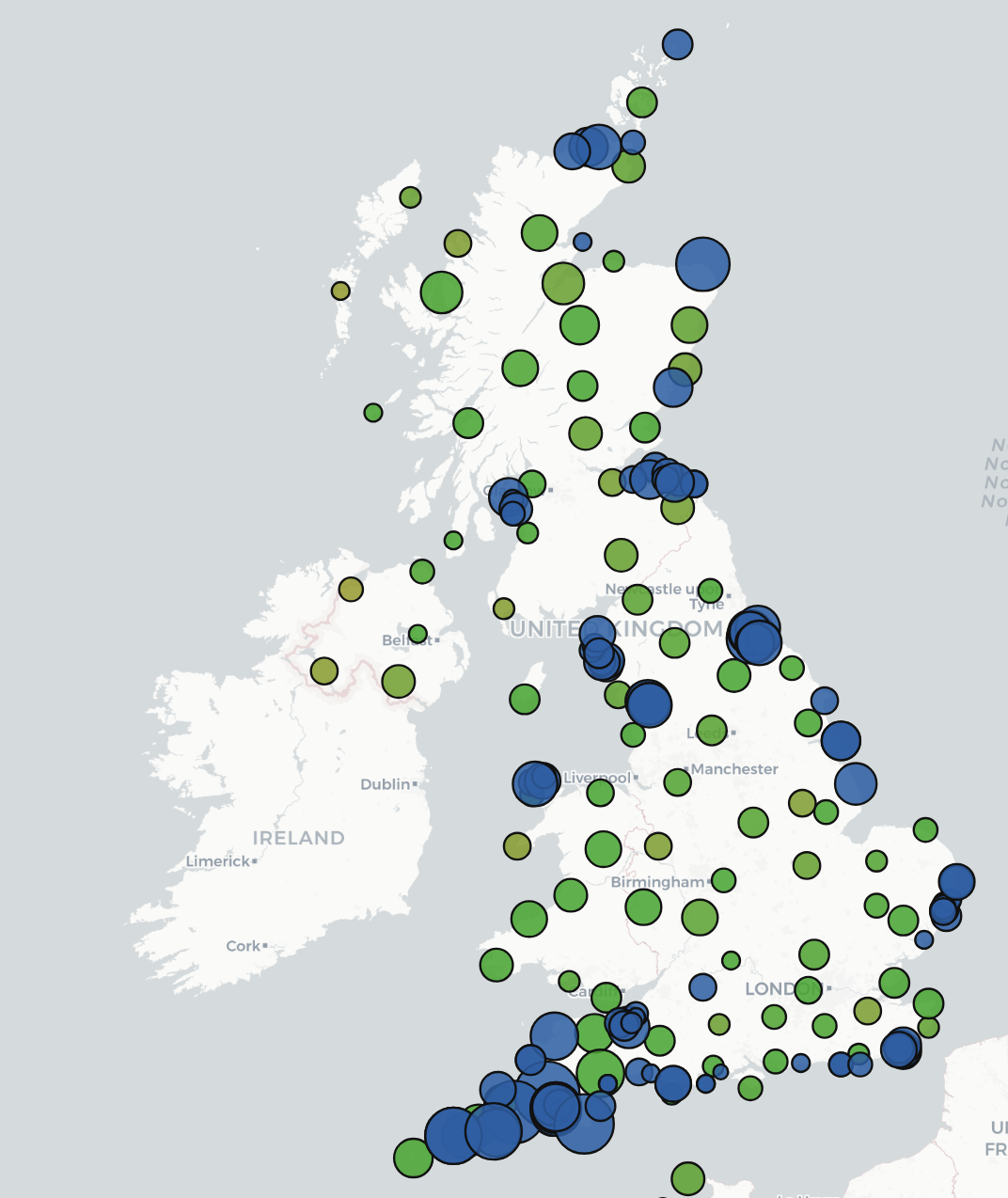
A live map of ambient gamma radiation across the UK, visualising real-time data from the UKHSA RIMNET monitoring network.

⚡️ Zapp 🐍 @ github
Zapp is a Python tool to automatically generate and maintain python module interfaces. Zapp is inspired by the modular monolith architecture and is designed to compliment the awesome tach package.
Open source and free to use! 🌍
Written in rust 🦀
Installed via pip 🐍
© 2026 Abie Marshall. Built by me! Using Gatsby + React + Chakra UI
Icons made by Freepikfrom www.flaticon.com
Backgrounds customised at SVG Backgrounds